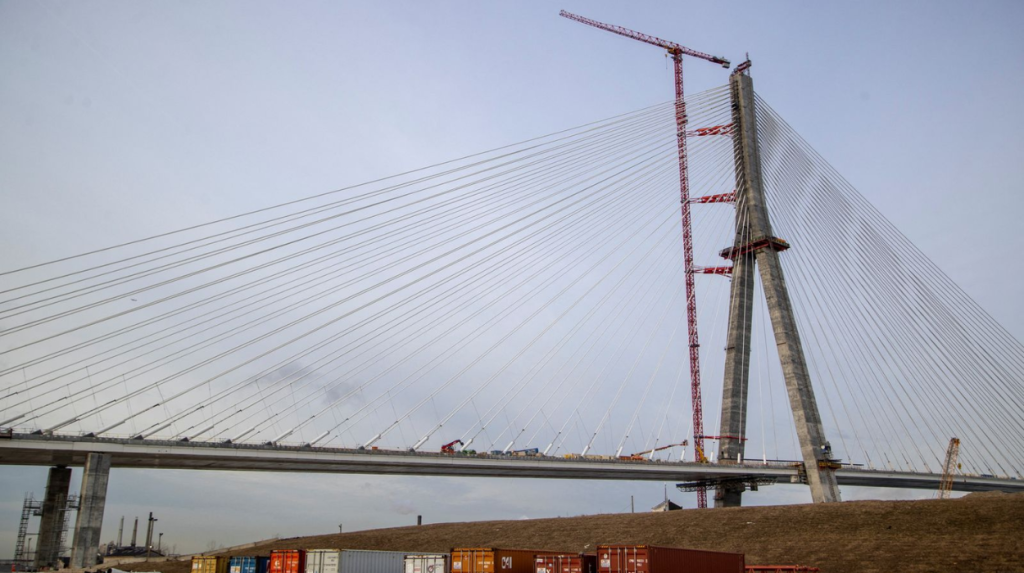
The threat that President Donald Trump issued on social media against the opening of the Gordie Howe International Bridge comes as the latest demonstration of the latter’s way of continually intermixing politics with misrepresentations and omissions. As the scheduled opening of the bridge that links both Detroit and Windsor is near, the misleading representations that President Trump made about the ownership of the bridge were interspersed with a bizarre claim about ice hockey.
Contradictions With His Own Past Support
Trump’s current disapproval of the bridge is a far cry from his earlier approval and support of the construction of the same during the early period of his presidency. His then-prime minister, Justin Trudeau, issued a joint statement in February 2017 hailing the bridge and urging the expedient construction of the same, calling it an important economic link between the two nations.
This has not gone uncommented on. Former Conservative MP from Canada Jeff Watson showed the inconsistency thus:
“Trump, who earlier expressed support for ‘accelerating’ construction, now is trying to use the bridge as hostage in a trade fight of his own creation”.
The shift implies a political recalculation, not a policy concern.
Ownership Already Shared Between Michigan and Canada
One of Trump’s central assertions—that the United States should own “at least one half” of the bridge—ignores the existing ownership structure. The bridge is already jointly owned by the state of Michigan and the Canadian government on a 50/50 basis, a fact confirmed by government officials on both sides of the border and reiterated by former Michigan Governor Rick Snyder.
Snyder publicly dismissed Trump’s claim, emphasizing that the ownership arrangement Trump demanded is already in place, raising questions about whether the president was unaware of the details or deliberately misrepresented them.
Canada Covered the Entire Construction Cost
Trump’s demand that the United States be “fully compensated” for what it has “given” Canada is particularly misleading. In reality, Canada financed the entire multibillion-dollar construction of the bridge after Michigan lawmakers declined to contribute funding. Canada intends to recoup its investment through toll revenues, after which toll income will be shared with Michigan.
Trump’s failure to clarify what compensation he was seeking—whether related to the bridge or broader trade issues—adds to the confusion and suggests the threat was more rhetorical than grounded in policy or legal reality.
False Claims About American Steel and Labor
Trump also claimed that Canada built the bridge with “virtually no U.S. content,” accusing the Obama administration of granting a waiver to bypass Buy America rules. While it is true that a waiver was issued, the rationale was that Canada was assuming all financial risk and American companies were allowed to compete fairly.
According to Trump, the US did not participate. However, US steel and labor participated in the construction of the bridge, contrary to Trump’s assertion. Officials from Canada and Michigan also stated that US steel and labor were used. Some of these officials include Canada’s Mark Carney, Windsor Mayor Drew Dilkens, Ontario Premier Doug Ford, and former Governor Snyder. According to Premier Ford of Ontario, although the majority of the materials used came from Canada due to funding responsibility, most of the US steel and labor were used.
These statements directly contradict Trump’s narrative, reinforcing the perception that his claims were exaggerated or inaccurate.
Political Theater Over Infrastructure Reality
Trump’s threats over the Gordie Howe International Bridge appear less rooted in factual concerns and more in political signalling amid broader trade tensions. By ignoring documented facts, omitting his past endorsement, and exaggerating U.S. exclusion from the project, Trump framed the bridge as a symbol of American exploitation—despite evidence showing it to be a cooperative bilateral infrastructure venture.
The episode underscores a recurring pattern in Trump’s rhetoric: dramatic declarations that generate headlines but collapse under factual scrutiny. In this case, the bridge stands not as an example of Canada taking advantage of the United States, but as a rare instance of cross-border collaboration that Trump himself once praised—before deciding to rewrite the narrative for political leverage.