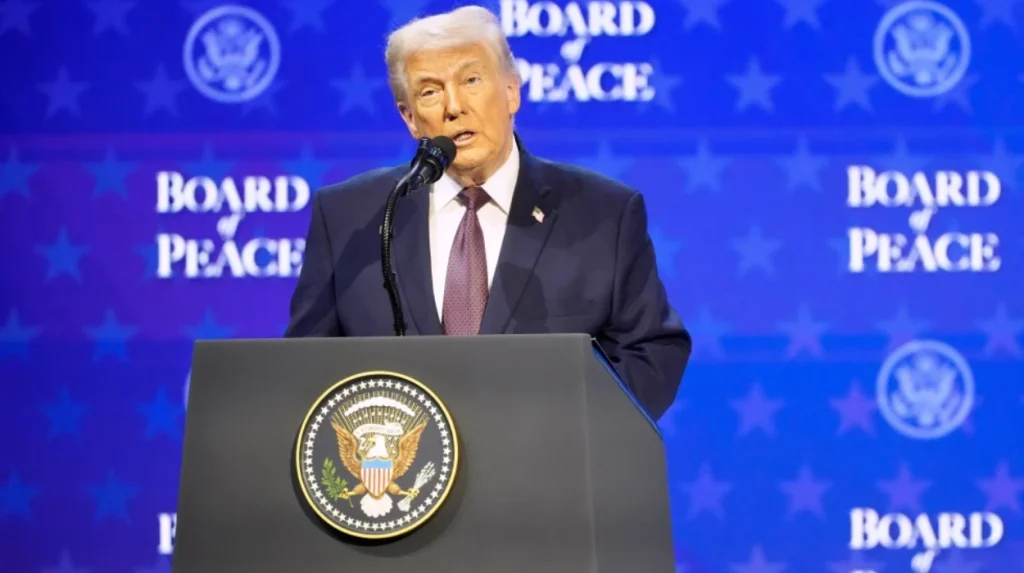
President Trump has announced that the inaugural session of his newly formed Board of Peace would be held in Washington this month, with the sole agenda of raising funds for the reconstruction of the Gaza region. The board meeting, which is slated to take place on February 19, would be attended by other leaders the president has invited, as well as members of the newly formed executive committee that would oversee the administration of Gaza.
But it also raises fundamental questions of legitimacy, global governance, and the issue of whether the United States is trying to reshape the international system outside established multilateral frameworks.
The formation of a U.S.-run peace board signals what could well be a momentous break from more than five decades of United Nations-dominated international conflict-resolution mechanisms, supplemented by regional organizations and international financial institutions.
Is This a Humanitarian Initiative or a Geopolitical Power Play?
Trump’s board of peace was developed conceptually as a solution to the Israeli-Hamas conflict in Gaza, where the humanitarian cost has been disastrous. The UN Office for the Coordination of Humanitarian Affairs has reported that the ongoing conflict has led to the displacement of over 1.7 million individuals, i.e., over 75% of the Gaza population, along with tens of billions of dollars in infrastructure damage.
The World Bank and UN agencies have expressed that the rebuilding of the Gaza infrastructure could cost over $40 billion, depending on the extent of damage and governance structure
Still, the larger scope of Trump’s plan may be seen to be geopolitical in nature. Indeed, reports indicate that the board’s remit will include efforts to resolve world crises beyond Gaza, implying that the initiative is, in fact, not entirely geared towards humanitarian rebuilding.
Why Is the Meeting Venue Controversial?
Such a meeting is expected to be held at the former U.S. Institute of Peace, currently rebranded as the Donald J. Trump U.S. Institute of Peace under ongoing legal disputes. The administration took over the facility last year and sacked most of its staff, fuelling fears about the involvement of politics within an institution that has traditionally been expected to function independently and focus on research on conflict resolution.
Critics argue that politicizing a peace institution undermines its credibility and risks transforming peace-building into a partisan geopolitical instrument rather than a neutral diplomatic effort.
Is the Board an Attempt to Sidestep the United Nations?
The Trump Board of Peace seems part of a larger game plan to sidestep other multilateral institutions, such as the United Nations Security Council, which has long been at the heart of global peacekeeping and conflict resolution. The UN system, since 1945, has overseen more than 70 peacekeeping missions, involving more than 2 million personnel at an annual cost of over $8 billion.
By establishing an alternative structure, the US risks diluting international consensus on principles of collective security. This has invited skepticism from its allies, who suspect the new initiative may subvert international laws and cause fragmentation in global governance, promoting US unilateralism.
Why Are U.S. Allies Hesitant to Join?
Apparently, many of the European and other allied countries’ governments have reportedly refused to participate, as they suspect the board could potentially operate as an alternative body to the UN security council. European diplomats have traditionally promoted multilateralism as a foundation of world stability, especially in the wake of the failure of unilateral actions in Iraq, Libya, and Afghanistan.
The hesitation is also seen as a broader expression of transatlantic strains about Trump’s foreign policy, which focuses heavily on unilateralism, transactionalism, and sovereignty.
Who Will Fund Gaza’s Reconstruction—and Under What Conditions?
The funding for reconstruction in Gaza still remains a highly politicized issue. In the past, Gulf states, the EU, the US, as well as international financiers, have channeled billions of funds into the Palestinian territories. In the recent past, between 2014 and 2022, around $5 billion was pledged for the reconstruction of Gaza after various conflicts that took place earlier.
Trump’s board could potentially redirect funding through U.S.-controlled mechanisms, raising concerns about conditionality, political leverage, and the marginalization of Palestinian authorities and international agencies.
Does This Signal a Shift in the Post–World War II International Order?
Trump’s move also fits into a larger pattern of competition between great powers and the weakening of the international system established in the post-World War II era. Since the end of the Cold War, global events have been driven by institutions like the UN, World Bank, IMF, and NATO. However, in the recent past, new systems have emerged, like the Chinese, Russian, and regional bloc systems.
In creating a U.S.-centric approach for peace, Trump might actually be hastening the disintegration of global governance models into multiple forms, each with its own institutional structure bearing the hallmarks of its geopolitical allegiance.
Is the Board Legitimate Without Broad International Participation?
The legitimacy of a solution in international conflict resolution derives from its inclusiveness, neutrality, and observance of international law. In the absence of the broad participation of allies, regional actors, and international organizations, Trump’s Board of Peace risks being perceived not as a credible peace-promoting mechanism but as a unilateral political project.
Without important stakeholders such as the UN, EU, Arab League, and African Union on the board, it may not function effectively or be genuinely legitimate, especially across the Middle East.
Could This Initiative Undermine Existing Peace Processes?
The existence of parallel diplomatic structures may hinder peace processes. In Gaza, a multitude of actors, including Egypt, Qatar, the UN, and the U.S., already assist in brokering ceasefires and humanitarian understandings. If a new American-led governing structure is introduced, it may negate existing frameworks, weaken Palestinian politics, and fuel existing geopolitical tensions.
Is Trump Redefining Peace Diplomacy—or Politicizing It?
Trump’s Board of Peace represents a bold and controversial attempt to reshape international peace diplomacy. While the stated goal of reconstructing Gaza is urgent and legitimate, the broader implications suggest a strategic effort to challenge multilateral institutions and consolidate U.S. influence over global conflict resolution.
Whether this initiative will contribute to peace or further destabilize international norms remains uncertain. What is clear is that it signals a potential turning point in global governance—one where unilateral power increasingly competes with collective international systems.