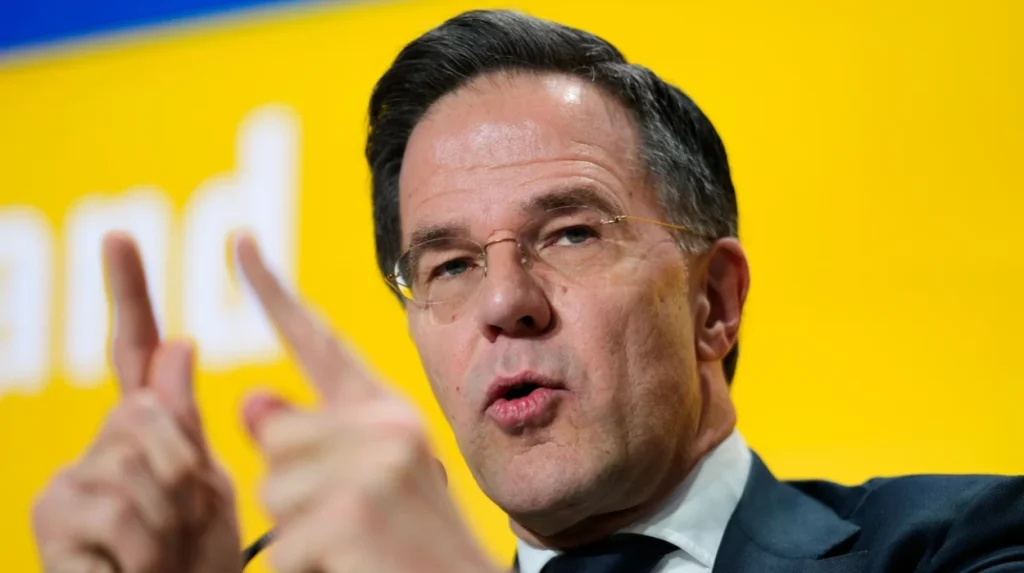
NATO Secretary General Mark Rutte delivered a blunt message to Europe on Monday: any belief that the continent can defend itself without the United States is a dangerous illusion. Speaking before members of the European Parliament in Brussels, Rutte sought to calm — and confront — growing anxieties about a widening rift between Washington and its European allies, intensified by President Donald Trump’s recent remarks on Greenland and European security.
“If anyone thinks here again that the European Union, or Europe as a whole, can defend itself without the U.S., keep on dreaming,”
Rutte said.
“You can’t. We can’t. We need each other.”
His warning comes at a moment of acute uncertainty for NATO, as transatlantic unity faces renewed stress from political volatility in Washington and mounting pressure from Russia and China.
Trump, Greenland, and Europe’s Strategic Anxiety
Rutte’s remarks followed days of unease that peaked last week after President Trump spoke at the World Economic Forum in Davos. There, Trump said he would not seize Greenland — an autonomous territory within the Kingdom of Denmark — stepping back from earlier threats that had alarmed European capitals. In the same speech, however, Trump openly belittled Europe, asserting that the continent would not exist without American power.
Trump had also warned of additional tariffs on European countries if they resisted his bid to exert control over Greenland, though he later backed away from those threats as well.
Despite the partial retreat, European officials remain wary. Many fear that Trump could reverse course again, particularly given his history of using economic and security pressure as leverage in negotiations with allies.
Rutte’s Delicate Balancing Act With Trump
A former Dutch prime minister, Rutte has cultivated a notably cordial relationship with Trump — a strategy that has raised eyebrows across Europe. On Monday, he openly backed the American president’s strategic focus on the Arctic and the need for stronger defenses around Greenland, arguing that the region’s importance has grown sharply as great-power competition accelerates.
Rutte also defended his own role in easing Trump away from escalating threats and steering him toward compromise. However, leaders in Denmark and Greenland have bristled at suggestions that their future might be discussed without their consent.
“Of course, I have no mandate to negotiate on behalf of Denmark, so I didn’t, and I will not,”
Rutte said.
“That’s up to Denmark to do.”
Pressure From European Lawmakers
Members of the European Parliament pressed Rutte for clarity about what exactly he discussed with Trump last week and what it might mean for Denmark and Greenland — both of which have categorically rejected any notion of an American takeover.
Rutte offered few specifics. He declined to elaborate on the “framework of a deal” that Trump claimed last week to have reached with NATO regarding Greenland’s future — an announcement that brought temporary relief after months of threats but also fueled concern that the situation remains unstable.
Rutte did say there were
“two work streams going forward”
involving Greenland.
NATO’s Arctic Calculations
The first work stream involves talks among NATO allies on a broader Arctic defense strategy that includes Greenland — the world’s largest island, much of which lies within the Arctic Circle and occupies a critical position between North America and Europe.
The second involves a separate process bringing together representatives from the United States, Denmark, and Greenland. That process began earlier this month in Washington and is ongoing, Rutte said. Danish officials confirmed that a meeting took place in Washington on Thursday but declined to disclose details.
Several Western officials have suggested that one compromise under discussion would grant the United States sovereign status over its military bases in Greenland. The U.S. has maintained a military presence on the island since World War II, when Nazi Germany occupied Denmark and the Danish ambassador to Washington signed an agreement allowing the United States to defend Greenland.
Following Rutte’s talks with Trump, Danish leaders moved quickly to reiterate that Greenland’s sovereignty remains a “red line.” Rutte, who addressed the European Parliament’s security and defense committee, declined to comment on the base-sovereignty proposal.
Europe Pushes Back on Sovereignty
The sharpest questions on Monday came from lawmakers representing countries most directly affected. Danish MEP Villy Søvndal was unequivocal.
“We’re not going to give any square meter to any country because of threats,”
he said.
The exchange underscored the political sensitivity surrounding Greenland, whose strategic value has risen dramatically as melting Arctic ice opens new shipping lanes and intensifies competition over resources and military positioning.
Europe’s Military Reality Check
Throughout his remarks, Rutte repeatedly praised Trump — at times joking that he knew doing so would irritate his audience. Trump’s bombastic Davos speech had rattled Europe, particularly his claim that without the United States, Europeans would now be
“speaking German and a little Japanese, perhaps.”
Rutte adopted a more diplomatic tone but reinforced the underlying point: more than 70 years after World War II, Europe remains deeply dependent on American military power.
The United States accounts for the majority of NATO’s total defense spending and provides the alliance’s core nuclear deterrent, strategic airlift, missile defense, intelligence capabilities, and command infrastructure. While European defense spending has risen since Russia’s invasion of Ukraine, the gap remains vast.
Rutte argued that even ambitious spending targets would not be enough for Europe to stand alone.
“Forget that you can ever get there with 5 percent,”
he said, referring to NATO’s pledge for members to spend 5 percent of GDP on defense annually by 2035.
“It will be 10 percent. You have to build up your own nuclear capability that cost billions and billions of euros.”
And if Europe tried to go it alone, he added dryly:
“Hey, good luck.”
The Arctic, China, and Russia
Rutte also echoed Trump’s warning that China and Russia are becoming increasingly active and assertive in the Arctic — a region once viewed as peripheral but now central to global security calculations.
“President Trump is doing a lot of good stuff, I believe — I know, I’m irritating a lot of you again,”
Rutte said.
When it comes to Arctic defense, he added,
“I think he’s right.”
The message was unmistakable: for all the friction and frustration in the transatlantic relationship, NATO’s secretary general sees no realistic alternative to U.S. leadership — especially as competition intensifies at the top of the world.