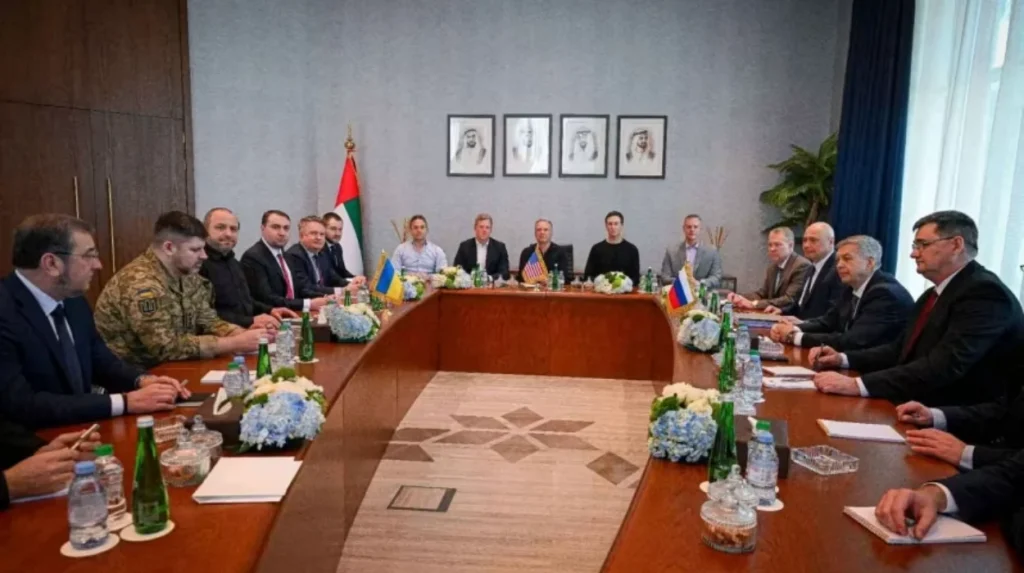
A meeting between the US, Ukraine, and Russia, the first since the Russian full-scale invasision of Ukraine last year, concluded on Saturday in the Emirates city of Abu Dhabi, with each side adopting an air of cautious optimism.
The officials indicated that the talks “surpassed expectations,” adding it was
“very upbeat, very positive, very constructive.”
The talks were the first time officials in Kyiv, Moscow, and Washington were together in the same negotiation format since the war in Ukraine began.
US Officials Point to Breakthrough After Months of Quiet Diplomacy
US sources report that the Abu Dhabi talks marked an important milestone after weeks of behind-the-scenes diplomacy. While it must still be said that there remains no guarantee of a final agreement, one US source explained that without face-to-face talks, no tangible progress would have been achievable.
“Getting to this place was a really big step,”
the official said, noting that the two sides were testing each other’s positions, approaching the issue creatively, etc.
Zelensky Signals Readiness for Further Talks
Ukrainian President Volodymyr Zelensky said in a statement that the discussions were substantive and constructive, adding that additional meetings could take place as early as next week.
“A lot was discussed, and it is important that the conversations were constructive,”
Zelensky said. He emphasized that the central focus of the talks was outlining possible parameters for ending the war. According to Zelensky, US officials proposed formalizing those parameters alongside the security conditions needed to achieve them.
“All sides agreed to report back in their capitals on each aspect of the negotiations and to coordinate further steps with their leaders,”
he said, adding that Ukraine is ready to move forward if there is broader readiness among the parties.
Territory and De-escalation Remain Core Issues
US officials echoed Zelensky’s assessment while acknowledging that significant obstacles remain, particularly on territorial questions.
“De-escalation is important. Yes, territory is important, as well, but we’ve eliminated lots of things that the parties couldn’t agree on before Geneva,”
one US official said, referring to an earlier failed round of talks in Switzerland.
“It’s important for us to keep up the momentum.”
According to US officials, the next round of talks is scheduled to begin on February 1, once again in Abu Dhabi.
Russia Seeks Framework Linked to Putin–Trump Understandings
Following the meeting, Russian Deputy Foreign Minister Sergei Ryabkov told state news agency TASS that Moscow aims to develop a plan that
“fully corresponds to the fundamental understandings”
reached by Russian President Vladimir Putin and US President Donald Trump during their summit in Alaska last year.
TASS reported that negotiations were conducted in both English and Russian and included discussions on buffer zones and various control mechanisms. However, territorial issues remain particularly difficult.
A UAE government spokesperson confirmed that the talks took place in a “positive and constructive atmosphere” and that Ukrainian and Russian representatives directly engaged on elements of a US-proposed peace framework.
High-Level Delegations Underscore Stakes of the Talks
Russia sent a military-heavy delegation to Abu Dhabi, including a senior intelligence official and the head of military intelligence. Ukraine was represented by top negotiators, including senior diplomats and security officials.
The US delegation included Trump’s envoy Steve Witkoff, Trump’s son-in-law Jared Kushner, and Josh Gruenbaum, commissioner of the Federal Acquisition Service.
US officials said Witkoff and Kushner had previously met with Putin in Russia for roughly four hours, describing the encounter as “very, very productive.” Discussions covered security, prosperity, frozen assets, territory, and de-escalation and included Kremlin aide Yuri Ushakov.
Donbas Remains the Central Territorial Dispute
Entering the talks, it was widely understood that territory remained the most contentious unresolved issue. The Kremlin has reiterated its demand that Ukraine withdraw from the Donbas region—an idea Kyiv has repeatedly rejected.
The Donbas comprises the coal-rich regions of Donetsk and Luhansk, once Ukraine’s industrial heartland. It was there, in an area with a significant Russian-speaking population, that Putin’s campaign to destabilize Ukraine began in 2014.
The region also contains a heavily fortified belt of industrial cities, railways, and roads that underpin Ukraine’s defensive and logistical network. Kyiv has spent years strengthening this area, and losing it would expose much of eastern Ukraine.
Russia’s Occupation and Pressure on Kyiv
Nearly four years after launching its full-scale invasion, Russia occupies about 20% of Ukraine’s internationally recognized territory. This includes almost all of Luhansk and parts of Donetsk, Kherson, and Zaporizhzhia.
The Trump administration has previously pressured Ukraine to accept a peace agreement, despite widespread concerns that such a deal could disproportionately favor Moscow.
Massive Russian Air Assault Underscores Fragility of Talks
The fragility of the diplomatic process was underscored by a massive Russian aerial assault launched just hours after the first day of talks concluded on Friday.
Ukrainian authorities said Russia carried out its largest overnight attack of the year, firing more than 370 drones and 21 missiles. Air defenses were activated over Kyiv, where CNN journalists reported hearing explosions.
At least one person was killed and four wounded in the capital, according to Mayor Vitali Klitschko. Falling debris sparked fires and damaged buildings, leaving nearly 6,000 apartment blocks without heat and cutting off water supplies in parts of the city. Temperatures in Kyiv dropped to minus 12 degrees Celsius (10 degrees Fahrenheit).
Attacks Hit Energy Infrastructure and Civilian Sites
Ukraine’s second-largest city, Kharkiv, also came under heavy attack. Strikes damaged a maternity hospital and a dormitory housing displaced people, Mayor Ihor Terekhov said. At least 19 people were wounded, including a child.
Other targets included the regions of Sumy and Chernihiv. President Zelensky said the attacks focused on Ukraine’s energy sector, which he described as “critical” during the winter months.
Ukraine’s Energy Minister Denys Shmyhal said Saturday evening that more than 800,000 residents in Kyiv were without power due to emergency outages following the strikes.