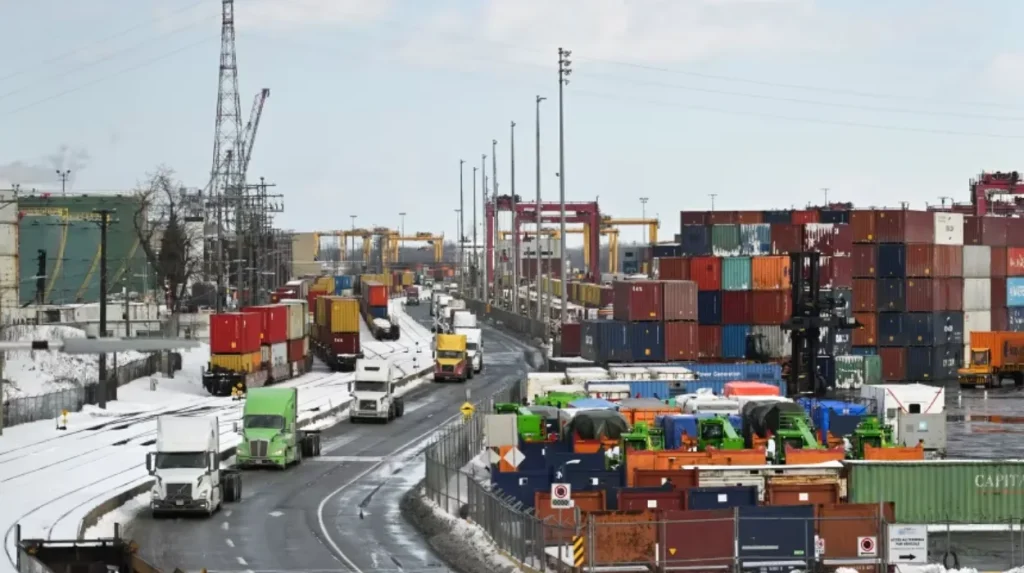
The threat by President Donald Trump to impose sweeping 100 percent tariffs on Canadian imports represents a dramatic escalation in what was already a highly strained bilateral relationship. By threatening that Canada could become a “drop-off port” for Chinese goods bound into the United States, Trump reframed Ottawa’s limited trade engagement with Beijing as an existential economic and security threat to the United States. The rhetoric is dramatic; the political, economic, and strategic implications are all too real.
The remarks widen an increasingly bitter divide between Trump and Canadian Prime Minister Mark Carney, combining trade policy with geopolitical rivalry against Beijing in a potentially explosive cocktail.
From Trade Partner to Political Target
Moreover, not only is it America’s second biggest trade partner, with a trade exchange exceeding $900 billion on a yearly basis, but Trump’s words imply that he’s willing to deal with Canada not only as a friend but almost as a threat to America’s strategic security too. The fact that Trump used the term ‘governor’ to refer to Carney not only represents mockery, but it also represents a narrative which Trump himself has often tried to sell to the audience: how Canada has been economically dependent on, and subservient to, America.
This formulation also allows Trump to take extreme measures by justifying their employment. When America is characterized as having a vulnerable aspect of its economic security vis-à-vis China, retaliatory tariffs can appear as protective acts.
The China Factor: Substance or Pretext?
At the heart of the perception of Trump’s threat lies Canada’s latest dealings with China, including its “new strategic partnership” – a term that followed the meeting between Carney and Xi Jinping. The partnership involves reducing barriers on Chinese electric vehicles with the intention of easing Chinese trade barriers with Canada in exports such as Canadian peas, lobster, and canola.
Nevertheless, Canadian authorities stress that this does not imply any kind of free trade agreement. Canadian Finance Minister Dominic LeBlanc has said that they are actually addressing questions regarding particular tariff issues and are not concerning themselves with any sort of free trade agreement with China. The significance of this is also amplified by the fact that the USMCA provides that any party may choose to opt out of the agreement should another party enter into a free trade agreement with a ‘non-market economy.’
The ambiguity over what constitutes a “deal” raises the possibility that Trump’s threat is less about legal thresholds and more about political signaling.
A Sudden Reversal in Trump’s Own Position
There is also a sense of inconsistency within Trump’s position, particularly given the fact that the last time the issue had been mentioned, Trump said it would “be a good thing” for Carney to make a trade deal with China.
In this context, analysts note that it is also possible Carney struck a nerve with his prominent warnings at last month’s annual conference in Davos, Switzerland, of powerful nations employing trade, tariffs, and supply chain warfare – without mentioning the US, his words were seen as relating to President Trump-style economic protectionism.
Davos, Greenland, and the Politics of Retaliation
Trump’s threat against Canada also follows a failed attempt to pressure European countries with tariffs over Greenland. After vowing to impose 10% duties on multiple European allies unless the US gained control of the territory, Trump later claimed tariffs were unnecessary once a framework was reached.
Trade experts see a pattern. When one coercive trade gambit loses momentum, another target quickly emerges. As one analyst put it, Trump may be “lashing out” after being overshadowed at Davos and frustrated by limited success in earlier tariff threats.
Economic Consequences for Canada—and the US
If implemented, 100% tariffs would be economically devastating for Canada, particularly for sectors already hit by US duties on autos, steel, aluminum, lumber, and energy. Canada’s unemployment rate recently reached a nine-year high, underscoring its vulnerability to further trade shocks.
Yet the damage would not be one-sided. Canadian consumer boycotts have already taken a toll on the US economy. Cross-border land travel from Canada to the US is down 31% this year, while American spirits exports to Canada collapsed by 85% in the second quarter. Imposing harsher restrictions on Canada than on China itself could also disrupt integrated North American supply chains, especially in manufacturing and agriculture.
Legal and Institutional Constraints on Trump’s Tariffs
There is also a looming legal question. Trump has relied on emergency powers under the International Emergency Economic Powers Act to justify tariffs, but the Supreme Court is expected to rule soon on whether that authority actually extends to trade measures. Several justices have expressed skepticism, noting that the law makes no explicit reference to tariffs.
A ruling against the administration could sharply limit Trump’s ability to follow through, reinforcing perceptions that his tariff threats are more rhetorical than real.
The “TACO” Effect and Investor Skepticism
In financial circles, Trump’s tariff brinkmanship has earned a nickname: “TACO,” or
“Trump Always Chickens Out.”
Investors have increasingly discounted such threats, assuming they will either be watered down or abandoned altogether.
Even so, economists warn that the uncertainty itself carries costs. Erratic and unpredictable trade policy discourages investment, disrupts planning for businesses on both sides of the border, and undermines confidence in US economic leadership.
Beyond Tariffs: A Crisis of Trust Between Allies
The heated exchange of words between Trump and Carney underscores a deeper issue. When Trump declared that
“Canada lives because of the United States,”
Carney’s response—that Canada
“thrives because we are Canadian”
—was more than a rebuttal. It was a statement of sovereignty in the face of economic coercion.
Ultimately, the tariff threat reflects a broader rupture in the US-led economic order, where even close allies are increasingly treated as leverage points rather than partners. Whether or not the 100% tariffs ever materialize, the episode reveals how fragile North American economic cooperation has become in an era of weaponized trade and geopolitical rivalry with China.