The Nobel Prizes have long occupied a rare space in global politics and culture: a symbol of intellectual brilliance, moral authority, and international legitimacy. For more than a century, receiving a Nobel Prize—particularly the Peace Prize—has conferred not just fame and money, but a claim to historical significance. The Peace Prize, established by Alfred Nobel’s 1895 will to reward those advancing “fraternity between nations,” has always been political, but it has also aspired to stand above raw political theatre.
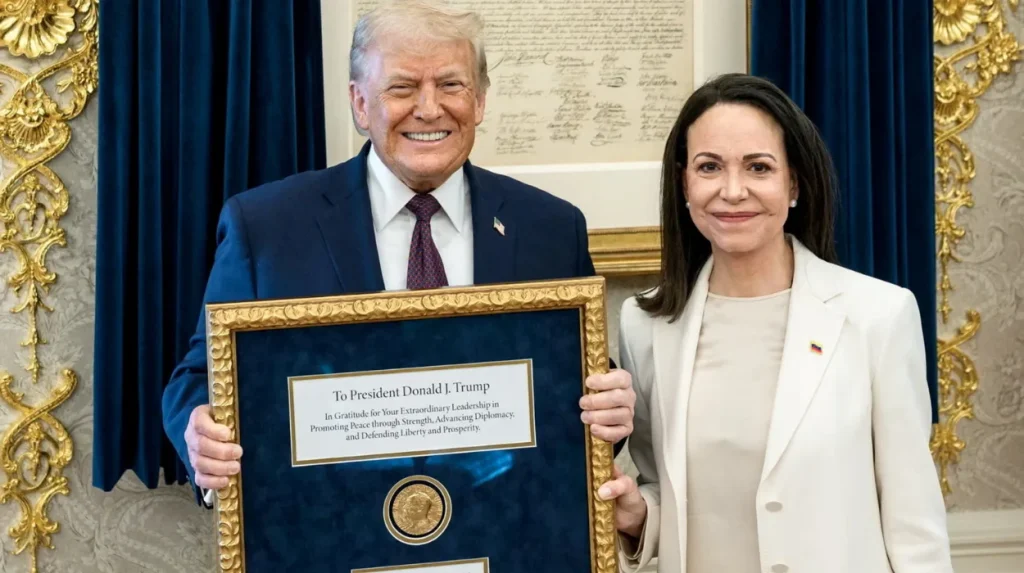
That aspiration took another blow this week when Venezuelan opposition leader María Corina Machado presented her Nobel Peace Prize medal to US President Donald Trump during a White House meeting. The gesture was met with Trump’s visible satisfaction, even enthusiasm. On the surface, it appeared farcical. At a deeper level, it exposed how fragile the symbolic authority of the Nobel Peace Prize has become—and how easily it can be instrumentalised by power.
Is This Just Absurd, or Is It Actually Dangerous?
There is something undeniably absurd about the image: a president who has openly coveted the Nobel Peace Prize, failed to receive it, accepted a self-styled “FIFA Peace Prize,” and now holds another person’s Nobel medal—despite the Nobel Committee’s explicit insistence that the prize itself cannot be transferred, shared, or re-awarded.
But treating the incident as mere comedy risks missing the larger problem. Symbols matter in global politics. The Nobel Peace Prize functions as a moral currency, a shorthand for legitimacy. When that currency is casually handed over to curry favour with power, its value is diluted—not just for this recipient, but for future ones.
This was not a private act of gratitude. It was a calculated public performance, staged in the most powerful political venue in the world.
Why Did María Corina Machado Do This?
Machado’s motivations are difficult to separate from political desperation. Awarded the Nobel Peace Prize in October for her opposition to Venezuelan President Nicolás Maduro, she was hailed by the committee as someone who
“keeps the flame of democracy burning amid a growing darkness.”
At the time, the prize was widely interpreted as a rebuke to authoritarianism in Caracas.
Yet geopolitics moved quickly. By January, the Trump administration’s efforts to unseat Maduro had faltered. Washington shifted tone, publicly questioning Machado’s leadership credentials and signalling openness to working with figures closer to the existing Venezuelan power structure. In this context, Machado’s gifting of the medal looks less like magnanimity and more like supplication.
Her Fox News remarks about wanting to “share” the prize with Trump appear to be an attempt to reinsert herself into Washington’s good graces. The Nobel medal, in this sense, became a bargaining chip—an object deployed in hopes of restoring relevance.
What Does Trump’s Acceptance Reveal About Power and Ego?
Trump’s response was telling. He described the gesture as a “wonderful sign of mutual respect,” framing it as validation rather than awkwardness. This aligns neatly with his long-standing fixation on personal recognition. Trump has repeatedly complained about not receiving a Nobel Peace Prize, arguing that his predecessors were undeserving and that his own diplomatic efforts—from the Abraham Accords to claims of resolving conflicts—have been ignored.
Accepting Machado’s medal allowed Trump to symbolically possess what the Nobel Committee denied him, without the burden of actually being awarded the prize. It was ego gratification disguised as diplomacy.
Crucially, there was no sign of discomfort over the Nobel Committee’s rules or the ethical implications. That indifference underscores how global norms matter little when confronted with power that does not recognise external moral authority.
What Has the Nobel Committee Said—and Why Does It Matter?
The Norwegian Nobel Committee and the Nobel Institute responded with unusual bluntness. “Once a Nobel Prize is announced, it cannot be revoked, shared or transferred to others,” they reiterated. The Nobel Peace Center added a crucial clarification: while a medal can physically change hands, the title of “Nobel Peace Prize laureate” cannot.
This distinction matters because the Nobel Prize is not supposed to be a transferable asset. It is a judgment, not a commodity. When recipients treat it as something that can be gifted to please powerful allies, the committee’s authority is implicitly challenged.
Yet the committee’s response also highlights its limitations. It can clarify rules, but it cannot control how laureates behave—or how political actors exploit the symbolism.
Can a Nobel Prize Be Bought, Sold, or Weaponised?
History shows that Nobel medals can be sold, often for reasons that enhance rather than diminish their moral standing. Dmitry Muratov’s decision to auction his Nobel Peace Prize medal for over $100 million to fund humanitarian work in Ukraine strengthened, rather than weakened, the prize’s reputation. Similarly, scientists who sold their medals to fund research framed the act as an extension of their life’s work.
Machado’s case is different. This was not a sacrifice for a cause, but a transfer to a powerful individual who neither earned nor rejected it. The medal was not monetised for public good; it was politicised for personal leverage.
That distinction is critical. When Nobel symbols become tools of lobbying, their moral clarity dissolves.
Can the Nobel Committee Undo Its Own Mistakes?
Formally, no. Nobel Prizes cannot be revoked, reconsidered, or appealed. This rigidity, designed to protect the prize from political pressure, has also locked the committee into defending decisions that later look deeply flawed.
History is filled with uncomfortable examples. Henry Kissinger’s 1973 Peace Prize, awarded while the Vietnam War continued, remains a stain. Aung San Suu Kyi’s fall from grace after the Rohingya crisis shattered the image of a moral icon. Ethiopian Prime Minister Abiy Ahmed’s 2019 award now sits uneasily beside the devastation of civil war.
Machado’s actions may not approach these cases in scale, but they raise the same underlying question: what happens when laureates undermine the values the prize claims to represent?
Is the Nobel Peace Prize Losing Its Moral Authority?
Experts are increasingly worried. Janne Haaland Matlary’s blunt assessment—that the committee may have erred in judging Machado’s character—points to a deeper institutional problem. The Nobel Peace Prize often rewards intention, symbolism, or opposition rather than long-term outcomes or ethical consistency.
Nina Graeger’s warning is even more stark: if the prize becomes a “bargaining chip,” its prestige will inevitably erode. Once the Nobel is seen as a political token rather than a moral judgment, its ability to shape norms weakens.
This erosion does not happen overnight. It happens through moments like this—small, awkward, but cumulative.