The announcement by US envoy Steve Witkoff that phase two of President Donald Trump’s Gaza plan has officially begun marks a pivotal—and highly contentious—moment in the trajectory of the war. Going beyond the fragile ceasefire, the second phase aims to transform the political, security, and administrative Gaza future through demilitarization, reconstruction, and the establishment of the technocratic Palestinian government.
At least in theory, this plan offers a manifestation of the most extensive effort been made so far in imposing a concept of post-conflict governance in Gaza. In reality, it lays bare significant contradictions between US visions, Israeli security demands, Palestinian politics, and humanitarian necessities.
From ceasefire mechanics to coercive leverage
Phase one of Trump’s 20-point plan delivered tangible, if limited, outcomes: a ceasefire agreed in October, a hostage–prisoner exchange, partial Israeli troop withdrawals, and a surge in humanitarian aid. Yet even these measures have proven fragile. Since the ceasefire took effect, Gaza’s Hamas-run health ministry reports nearly 450 Palestinians killed in Israeli strikes, underscoring how quickly the truce has frayed.
Phase two is framed as a transition from conflict management to conflict resolution. Witkoff described Gaza as moving
“from ceasefire to demilitarisation, technocratic governance, and reconstruction.”
However, his warning that Hamas must “comply fully” or face “serious consequences” reveals the coercive logic underpinning the plan. Rather than a negotiated political settlement, phase two relies heavily on pressure, enforcement mechanisms, and external oversight.
Demilitarisation as the central fault line
Phase two of this plan has at its core
“the complete demilitarization of Gaza, including the disarming of Hamas, PIJ, and other terrorist groups.”
This condition of the plan is clearly its most ambitious and irrational component.
The Palestinian resistance movement Hamas declared that it will not surrender its arms before the establishment of an independent Palestinian state with Jerusalem as its capital. In this sense, it is crucial to define what arms mean for Hamas. They are not only means of resistance but rather a basis for their political legitimacy.
Israel, meanwhile, insists that demilitarisation is non-negotiable but has stopped short of committing to a full military withdrawal from Gaza. Israeli officials argue that continued security control is essential to prevent Hamas from rearming, creating an inherent contradiction: Gaza cannot be truly demilitarised while under open-ended Israeli military oversight, nor can Hamas be expected to disarm under occupation.
Technocratic governance and the illusion of neutrality
The establishment of a transitional administrative-technocratic authority—a National Committee for the Administration of Gaza (NCAG)—comes as an administrative solution in politics. The committee was headed by ex-paid official of the Palestinian authority, and 15 members strong; it has gained a rare popularity from Hamas and the PA.
However, the history of technocratic rule in Gaza remains troubled. “Previous efforts at depoliticizing governance have failed because of the forces of factional competition, external intervention, and lack of legitimacy.” Without electoral, security, or fiscal power in its own right, the NCAG might become little more than a fig leaf covering the reality of governance in the Gaza Strip.
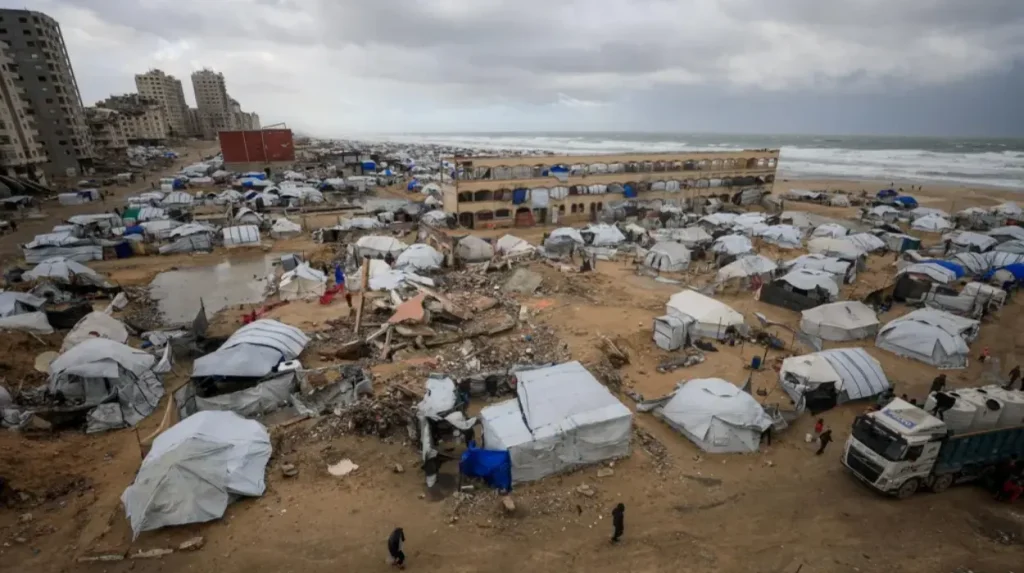
The challenge is compounded by Gaza’s devastated institutional landscape. According to UN estimates, over 60% of government buildings have been damaged or destroyed since October 2023. Courts, police stations, municipal offices, and ministries barely function, making governance less a matter of expertise and more a question of basic capacity.
The “Board of Peace” and personalised diplomacy
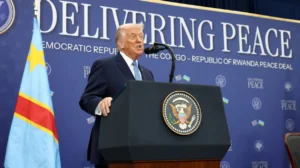
Perhaps most unusual, however, is Trump’s idea to create a “Board of Peace” which he would personally head. This personalized oversight mechanism represents a sharp deviation from the norms of multilateral conflict resolution and raises a number of concerns over accountability, continuity, and legitimacy.
The board is likely to be represented on the ground by Nickolay Mladenov, a former UN Middle East envoy. Although Mladenov has broad experience, his authority will hinge on buy-in from actors that fundamentally distrust US mediation. The perception that Gaza’s future is being managed by a board chaired by a sitting US president-particularly one aligned closely with Israeli positions-risks deepening Palestinian scepticism rather than fostering consent.
International stabilisation force and security dilemmas
Trump’s plan also envisages the deployment of an International Stabilisation Force (ISF) to train and support vetted Palestinian police units. While details remain vague, such a force would face immense operational challenges.
Past international security missions in Palestinian territories, including EU-led policing efforts, have struggled amid political fragmentation and overlapping chains of command. Any ISF would operate in an environment saturated with unexploded ordnance, armed factions, and unresolved sovereignty disputes. Without a clear political horizon, stabilisation risks becoming containment rather than peacebuilding.
Moreover, no countries have yet publicly committed troops, raising doubts about whether the ISF will materialise beyond planning documents.
Humanitarian catastrophe overshadowing political transitions
Even as political frameworks are debated, Gaza’s humanitarian crisis continues to deteriorate. The UN estimates that more than 80% of Gaza’s population is internally displaced, with over half facing acute food insecurity. Water and sanitation systems have largely collapsed, and the World Health Organization reports that fewer than a third of hospitals are partially functional.
The UN has repeatedly stressed the need for unrestricted humanitarian access, warning that reconstruction cannot begin while aid flows remain politicised and inconsistent. Linking humanitarian relief to demilitarisation benchmarks risks turning civilian survival into a bargaining chip, further eroding trust in the process.
Hostages, grief, and the politics of delay
The unresolved fate of Ran Gvili, the last dead Israeli hostage held in Gaza, has become a potent symbol of the plan’s fragility. Israeli Prime Minister Benjamin Netanyahu has made clear that his return remains a top priority, with families insisting that “there is no phase two” until Gvili’s body is recovered.
Israel has accused Hamas of deliberately delaying the handover and has frozen the reopening of the Rafah crossing in response—despite this being a phase one obligation. This standoff illustrates how humanitarian, political, and emotional pressures are deeply intertwined, and how easily the entire framework can be derailed by unresolved grievances.
A staggering human toll and unresolved accountability
The scale of destruction in Gaza casts a long shadow over any transitional plan. Since October 2023, more than 71,430 Palestinians have been killed, according to Gaza’s health ministry, alongside widespread displacement and infrastructural collapse. On the Israeli side, the Hamas-led attack killed around 1,200 people and abducted 251.
Without mechanisms for accountability, justice, and reconciliation, technocratic governance risks appearing disconnected from lived realities. For many Palestinians, reconstruction without political rights resembles managed containment rather than peace.
A transition without a destination
Phase two of Trump’s Gaza plan aspires to transform war into order through demilitarisation, technocracy, and external oversight. Yet it remains strikingly vague on Gaza’s final political status. While the Palestinian Authority is slated to take over governance after reforms, no timeline, guarantees, or sovereignty framework has been provided.
In the absence of a credible path to statehood, demilitarisation becomes coercive, governance becomes symbolic, and reconstruction becomes conditional. Rather than resolving the conflict, phase two risks freezing it into a new, externally managed equilibrium—one that may prove as unstable as the war it seeks to replace.
In this sense, the launch of phase two is less an endgame than a high-stakes experiment, testing whether Gaza can be reshaped without first resolving the fundamental political questions that have fuelled the conflict for generations.