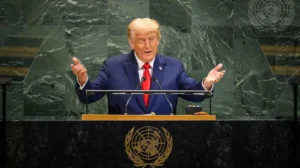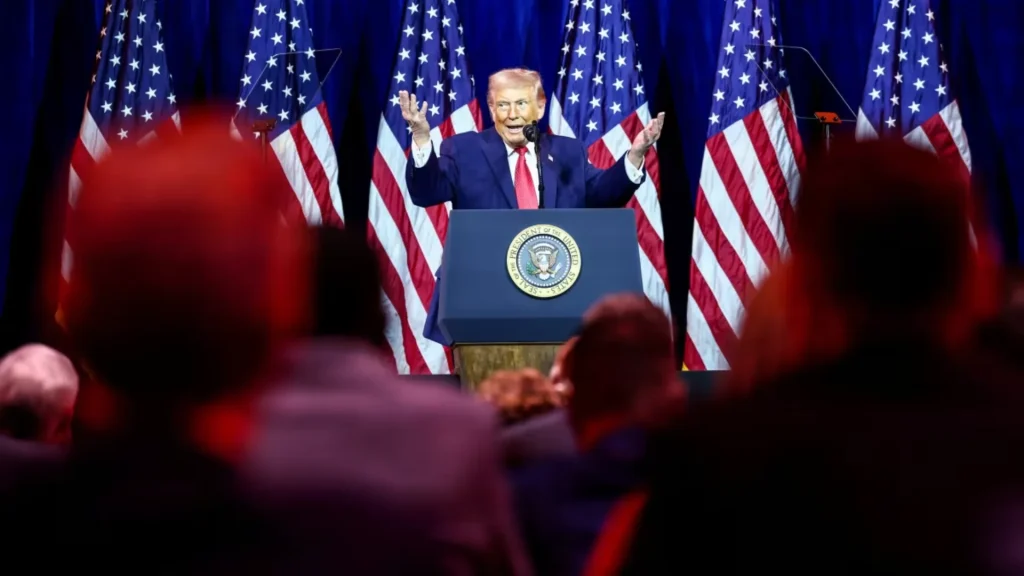
After five years in the Oval Office, Donald Trump appears to have reached a stark conclusion about the nature of power. In an interview with The New York Times published Thursday, the US president said there was only “one thing” that could restrain him globally:
“My own morality. My own mind.”
He added bluntly:
“I don’t need international law.”
The remarks were a rare moment of self-reflection, but one that alarmed allies and adversaries alike. For many outside the United States, they confirmed a growing fear: that the world’s most powerful country is now guided less by rules and norms than by the personal impulses of its leader.
How has Trump turned foreign policy into a personal power project?
The comments followed a week that starkly illustrated how American power is increasingly exercised as an extension of Trump’s character — volatile, unapologetic and performative. At home and abroad, legal and constitutional constraints appear secondary to presidential will.
Trump has long dismissed international law, multilateral institutions, treaties and alliances as burdens rather than force multipliers. But now, more than at any point in his presidency, he is acting on that worldview, reshaping US foreign policy into a blunt instrument of coercion.
Did the Venezuela raid cross legal and constitutional lines?
The daring US special forces raid that seized Venezuelan President Nicolás Maduro from his residence marked one of the most extraordinary uses of American military power in decades. The operation violated Venezuelan sovereignty and international law, and critics argue it likely exceeded the president’s constitutional authority to deploy force without congressional approval.
Yet Trump’s own words suggest such concerns did not weigh heavily. His personal moral calculus, rather than legal frameworks, appears to have governed the decision.
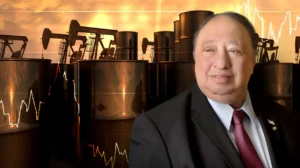
Why is Trump now claiming control over Venezuela’s oil?
Beyond the military action itself, Trump’s ambitions in Venezuela are even more striking. He has declared that the United States will oversee the country’s oil exports — a move critics describe as a revival of colonial-era politics Washington once claimed to oppose.
From the administration’s perspective, controlling Venezuela’s vast energy resources weakens rivals such as China and Russia, undermines Cuba’s economy and reinforces US dominance in the Western Hemisphere. But for many observers, the plan raises profound questions about sovereignty, exploitation and long-term occupation.
Is Trump reviving a new version of the Monroe Doctrine?
The White House’s latest national security strategy openly embraces what it calls a “Trump Corollary” to the Monroe Doctrine. It asserts that the United States has both the right and responsibility to prevent “hostile foreign incursion or ownership of key assets” in the hemisphere.
This so-called “Donroe Doctrine” is rooted in the belief that American power alone confers legitimacy. Yet critics warn it risks destabilizing the region and normalizing unilateral intervention under the guise of security.
Why is Greenland back on Trump’s agenda?
Trump’s expansive view of US entitlement extends far beyond Latin America. He has again expressed interest in acquiring Greenland, citing its growing strategic importance due to rare earth minerals and melting Arctic ice.
Despite Greenland’s status as a semi-autonomous territory of NATO ally Denmark — and despite the clear opposition of its population — Trump told the Times that “ownership is important.” More revealingly, he said controlling Greenland would give him something “psychologically needed for success.”
Such language has drawn uncomfortable comparisons to historic territorial grabs by authoritarian leaders, including Russia’s President Vladimir Putin.
Is strength now the only principle guiding US policy?
Trump’s deputy chief of staff Stephen Miller recently underscored the administration’s worldview, saying the global order is now governed by “strength, force and power.” It was a blunt acknowledgment that the US no longer sees itself as bound by the rules it once championed.
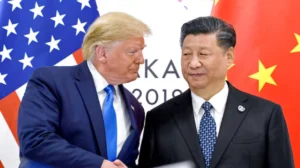
This shift places Washington alongside powers like Russia and China, which have openly challenged international norms in Ukraine and the South China Sea.
How is Trump consolidating power at home amid growing unrest?
Even as he pushes outward, Trump continues to wield aggressive authority domestically. His political standing has weakened due to fractures within the MAGA movement and a congressional backlash linked to the Jeffrey Epstein files. Yet the administration shows no sign of restraint.
This was evident in the handling of the killing of a 37-year-old woman in Minneapolis by an ICE agent. Despite video evidence contradicting official claims, senior officials framed the incident as justified and moved quickly to protect the broader immigration crackdown.
What risks does prolonged US control of Venezuela carry?
Trump has warned that US oversight of Venezuela could last far longer than initially suggested — possibly years. While the administration argues it will use oil revenues for the benefit of Venezuelans, critics note that these resources do not belong to the United States.
A prolonged American stewardship risks igniting regional backlash, fueling insurgency and trapping Washington in another open-ended intervention. Many experts also doubt whether offshore military power alone can effectively “run” a country as large and complex as Venezuela.
Could Trump’s rejection of international law destabilize the world?
International law was designed — largely under US leadership — to prevent great-power conflict and protect weaker states. Trump’s open rejection of that framework threatens to weaken it further.
By abandoning the rules-based order, the US risks encouraging rivals to act even more aggressively. Allies may question Washington’s reliability, while adversaries may feel emboldened to test the limits of force.
Is Trump repeating his 2016 doctrine on a global scale?
At the 2016 Republican National Convention, Trump famously declared:
“I alone can fix it.”
Nearly a decade later, that slogan appears to have evolved into a governing philosophy — not just for America, but for the world.
The question now is whether a global order shaped by one man’s “morality” and ambition can endure without spiraling into chaos.