A power vacuum was created abruptly in Venezuela as a result of President Nicolás Maduro’s dramatic abduction by the United States, causing chaos all over Venezuela.
Within hours of US air strikes hitting Caracas and other locations on Saturday, US President Donald Trump announced that Vice President Delcy Rodríguez had been sworn in as Venezuela’s interim president — a move that stunned observers and sidelined opposition leader María Corina Machado, last year’s Nobel Peace Prize laureate.
Trump found Machado to lack the necessary “respect” and support among her citizens to rule Venezuela, even though she was a close ally of his government and had praised him after winning the Nobel Peace Prize.
Instead, Trump claimed Rodríguez had engaged in talks with US Secretary of State Marco Rubio and was open to cooperation. “She was quite gracious,” Trump said, adding that Washington could not risk leadership that failed to align with what he described as the interests of the Venezuelan people.
Yet Rodríguez’s own response sharply contradicted Trump’s remarks.
Why did Rodríguez reject Washington’s narrative?
In fact, just after the strikes and arrest of President Maduro, Rodríguez called the American operation “brutal aggression,” adding that the president should immediately be freed.
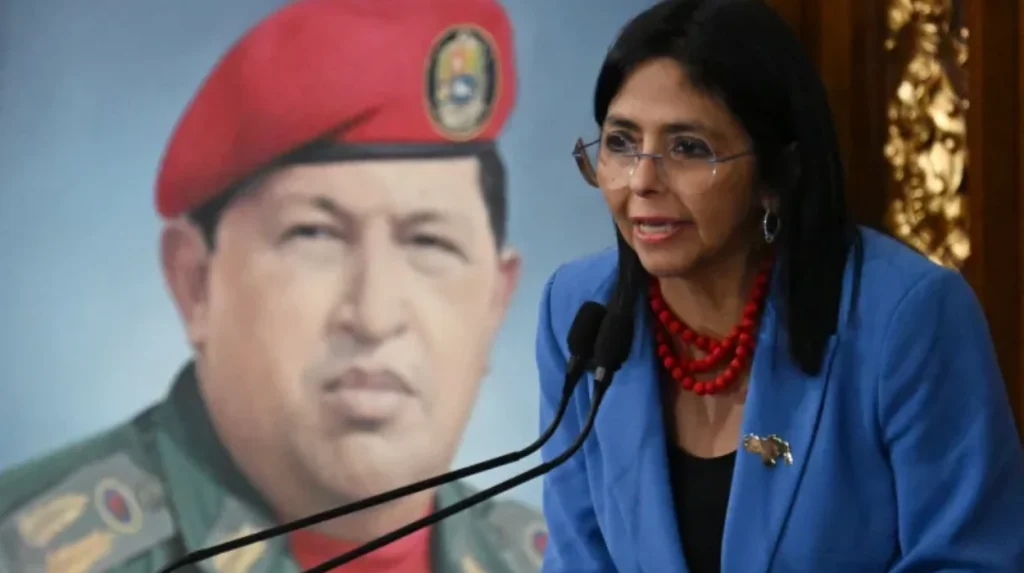
“This country always had and always will have only one president: his name is Nicolás Maduro,” she said on national television, accompanied by senior civilian and military leaders — a clear visual display of regime cohesion rather than transition. But her strong display of regime loyalty left very few questions unanswered: What power actually lies in Venezuela after Maduro’s ouster?
What are Delcy Rodríguez’s revolutionary roots?
Rodríguez was born in Caracas, Venezuela, on May 18, 1969, into a politically engaged family. She is the daughter of Jorge Antonio Rodríguez, the left-wing guerrilla leader who established the Socialist League in the 1970s. Rodríguez’s father died in 1976 after being tortured in police custody, which had a profound effect on the revolutionary generation in Venezuela, including a young Nicolás Maduro.
Also still connected to the government in a high-profile role is her brother, Jorge Rodríguez, who heads the country’s National Assembly – a very influential member of the government.
How did Rodríguez rise through Venezuela’s political ranks?
A trained attorney and graduate of the Central University of Venezuela, Rodríguez rapidly ascended within the Chavista movement over the past decade.
She was communications minister, foreign minister, and later the head of a pro-government Constituent Assembly set up in 2017, a body that gave more powers to Maduro and reduced the influence of opposition-led institutions. Internationally, Rodríguez has been one of the faces of the defense of the Bolivarian Revolution, carrying on the ideological legacy of former President Hugo Chávez in international politics.
Why is Rodríguez considered an economic power broker?
Unlike many figures rooted in Venezuela’s military past, Rodríguez is often viewed as comparatively pragmatic.
Her simultaneous roles as vice president, finance minister, and oil minister positioned her at the center of Venezuela’s battered economy. She pursued more orthodox policies to stabilise hyperinflation and engaged cautiously with parts of the private sector.
In August 2024, Maduro expanded her authority further by assigning her direct oversight of the oil ministry, tasking her with navigating intensifying US sanctions targeting Venezuela’s most vital industry.
“This high-profile economic role likely made her a more attractive interlocutor for Washington,”
said Caracas-based journalist Sleither Fernández.
How did Rodríguez build bridges with US power circles?
Rodríguez cultivated relationships with influential Republicans in the US oil sector and on Wall Street, many of whom opposed direct US-led regime change.
Her past contacts reportedly included Erik Prince, founder of Blackwater, and more recently Richard Grenell, a Trump envoy who sought to broker an agreement granting Washington greater leverage in Venezuela while keeping Maduro in place.
These connections helped frame Rodríguez in US policy circles as a negotiator rather than a hardliner — an image now under strain.
Why does Maduro call her a “tiger”?
Despite perceptions of moderation, Maduro has repeatedly praised Rodríguez’s unwavering loyalty. Upon naming her vice president in 2018, he described her as
“brave, seasoned, the daughter of a martyr, revolutionary and tested in a thousand battles.”
Following Maduro’s abduction, Rodríguez adopted an uncompromising tone, demanding proof of life for both Maduro and First Lady Cilia Flores and warning of dangerous global precedents.
“What was done to Venezuela can be done to anyone,” she said.
“That brutal use of force to bend the will of a people can be applied against any country.”
What legal authority does Rodríguez hold now?
Later on Saturday, Venezuela’s Supreme Court Constitutional Chamber officially appointed Rodriguez as the country’s acting president. This is with regard to the preservation of continuity as well as sovereignty. With this ruling, Rodriguez will have the power to lead temporarily despite possible limits to some constituional rights to which she is entitled.
For now, Rodríguez stands at the centre of Venezuela’s most volatile moment in decades — publicly loyal to Maduro, legally empowered by the courts, and claimed by Washington as a potential partner, even as she denounces its actions.