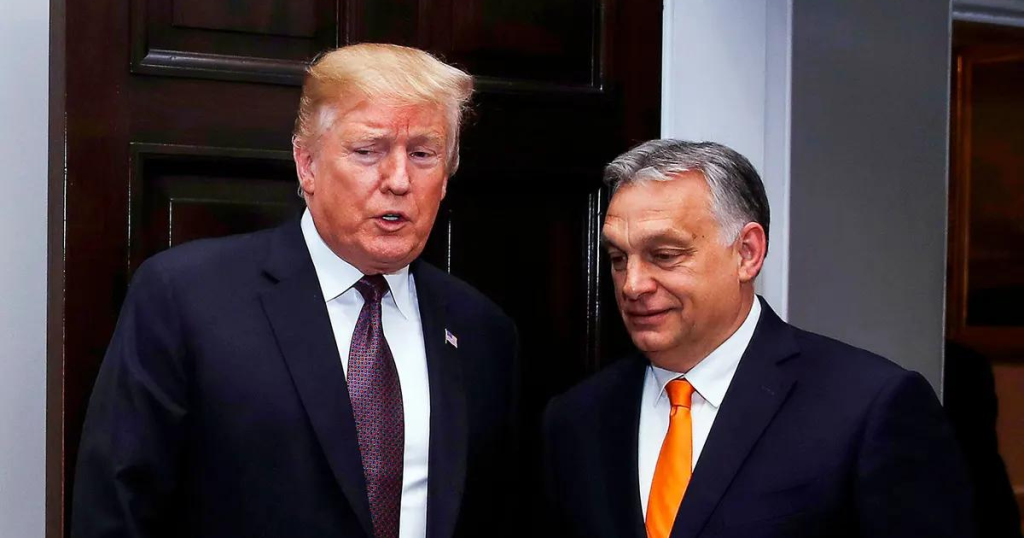
In light of the US and Europe gearing up for significant elections later this year, Viktor Orbán of Hungary is throwing his cards on the table by traveling to see Donald Trump. The long-serving prime minister of Hungary who has been repeatedly chastised by the US administration for democratic regression and his cozy ties to the Kremlin will go to the US without an invitation from the White House. He is not anticipated to meet with any members of the Biden administration, which is an almost unprecedented step for a leader of a NATO nation. Rather, before seeing Trump in Florida, he is expected to participate in a panel discussion alongside the chairman of the Heritage Foundation, a conservative think organization.
Orbán-Trump dynamics
Foreign policy circles are keenly monitoring the visit, which coincides with a low period in Hungary’s post-Cold War ties with Washington. This is partly because of concerns that Orbán would utilize his connection to the Republican presidential contender to further Kremlin talking points over Ukraine. Hungarian counterintelligence official Péter Buda stated, “The liberal international order is under very serious attack.” “Orbán, behaving like a gambler when it comes to foreign policy, has bet everything on this order collapsing and is hoping to obtain a more advantageous position if he commits himself ahead of time to the emerging powers of the east.
Significance of the visit
Buda stated that “one cannot be wrong to assume that Orbán is ultimately lobbying the US on foreign policy in favor of Russia.” Orbán and Putin “both focus on peace” discussions, which would surely benefit the Russians. The leader of Hungary has stated in the open that he hopes Washington and Brussels would change their foreign policy. In a speech earlier this year, Orbán stated, “With God’s help, Hungary’s room for maneuver will not be reduced but will be expanded to an extent that we have not seen in a long time. At the end of the year, the global political scene will look very different from how it looked at the beginning of this year.” He emphasized, “We would very much want to see President Donald Trump return to the White House and restore peace here in the eastern half of Europe, but we cannot meddle in other countries’ elections.
Criticism and concerns
There are eyebrows in Budapest and Washington over the scheduled meeting with Trump. “If Trump was truly the China hawk he purports to be, he would be questioning Orbán about cozying up to Beijing,” stated Katalin Cseh, a European parliament member who represents the Momentum opposition party in Hungary. She continued, saying, “But it appears Trump is more interested in cozying up to authoritarians himself.” “They might even be exchanging notes on how to undermine Nato to suit Putin’s interests,” she claimed. “Viktor Orbán’s mounting authoritarianism, including the recently enacted ‘Sovereignty Protection Act,’ is the main factor putting strain on Hungarian-American relations,” according to a statement sent by longtime Democrat Ben Cardin, the chair of the US Senate committee on foreign relations. The group behind Orbán has responded angrily to criticism. Balázs Orbán, the prime minister’s political director, stated that “there is undeniably a growing interest in Hungary among US conservatives, even though the present liberal administration in the US may not actively seek to strengthen ties with Hungary.”
Domestic and International reaction
He declared, “Prime Minister Orbán is coming to the US to deepen these ties.” It is not exceptional, in my opinion. Leaders travel often for a variety of purposes and interact with peers who share their interests and strategic aspirations. The journey is considered a component of Orbán’s ongoing endeavor to establish himself as a key player in a global conservative movement. Péter Krekó, the director of the Political Capital research institute in Budapest, said that for him, “it’s just a big, big moment in his foreign policy importance, and also he could hope that it makes him more serious in the eyes of others,” noting that US leaders typically did not give countries the size of Hungary much thought.
Final words
In conclusion, Traditional American conservatives do not get along with the Hungarian government, which retains ties to Beijing and Moscow, employs former communist security officers, and is notorious for distorting domestic commercial competitiveness. In 2014, the Republican John McCain, who passed away, called Orbán “a neo-fascist dictator.” Still, Orbán’s group has invested a great deal of time and resources in building bridges with an alternative faction of US conservatism. To boost its reputation, the Hungarian government has used US consultants with conservative ties in recent years.